Wednesday, March 28, 2012

Love of Place.


The love we feel for another human being, especially one we have spent many years beside, is also possible in our attachment to landscape, to place. Like close companions we have grown together, our minds and emotions intertwined: that city street we have walked since childhood, the beach that has been our emotional refuge in hard times, the mountain on the horizon that somehow anchors our personality. We are creatures of attachment, one of our nicer features.


Once we are grounded in this capacity, once we have practiced this for a long time, we find that we can love a greater number of places that are different from our own. The Gulf Islands are part of me, I am at home here, but the wide ocean, the Pacific Islands, the Tropical Savannah, can easily claim my love as well, perhaps because I have done it once already so well with the one.

Today I walked down to the valley below and along a familiar road, one I have walked years ago with my young children and still walk regularly these days with my wife. A cloudy day, Spring barely begun: brown leaves, bleached and beaten down grasses, a touch of snow, a complex texture of bare twigs arched over the mostly hidden little streams that wander down the hills. First frog chorus today though, robins beginning to break the winter silence, ducks chasing each other in the still half flooded fields. This familiar nondescript place is where I take my photographs today and I celebrate those browns and greys, the tattered green bramble leaves still hanging around from last season.

I see this landscape through my own experienced eyes, a place I love even though I might not usually name that feeling. I have been helped to that realization by the work of the artist Andrew Wyeth who brought out the same qualities in his paintings of the north-eastern United States. I study his paintings, feel them, and I can then reach deeper into an appreciation of my own tattered, dark, late winter landscape.


Thursday, March 22, 2012

The Snow squall.


It must seem funny to people in naturally snowy climates for me to be rushing out with my camera as soon as a snow cloud rolls across the sun, but really the opportunities to try different camera settings and capture the side-blown streaks of a dense, brief snowfall have not come that often this winter.


All too soon the sun is out again and all that sturm und drang filters down to a skiff of snow wrapped around the Spring snowdrops, whitened branches and roadside grass. It is the contrast between the snow and the spring- new leaves, buds and flowers that leads me out for a walk down our neighbourhood roads.


Those roads gleam grey and wet in the evening light, the trees flare-up in the shafts of light as they transform quickly from snow to water droplets. It is a surprisingly dramatic few minutes of subject matter while this melt takes place. And I am out here to record it: the precision of this moment.


Monday, March 19, 2012

Reginald Hill on Saltspring Island


Ever since we discovered the excellent British crime writer Reginald Hill we have laughed a little over our local mountain of the same name. I had been working my way higher and higher up its rocky slopes from Indian Point over the past couple of weeks and finally decided to actually climb to the summit on an established trail that begins from the Fulford Harbour side. I bought a good hiking book (“Hiking the Gulf Islands’ by Charles Kahn) and drove to the beginning of the trail. “Strenuous, steep trail”, said the guide and sure enough I soon found myself climbing a wet, rocky hillside that was clothed in moss and second growth forest. Puff, puff, Bill is out of shape, but with a stick to aid me I scrambled upward out of the shadows toward the sunlight. It was a frosty March morning on the shady side of the hill, but I was never-the-less reminded of a similarly steep trail in Samoa that lead in tropical heat up the slopes of another hill on the top of which was Robert Louis Stevenson`s grave. Perhaps it was the same combination of steep trail, early morning, the lure of bright sunlight at the summit and the hopes of a wider perspective. When I finally reached the mossy top of the hill I could see for miles, across the Burgoyne valley towards Mount Maxwell and the distant snowy mountains of Vancouver Island in one direction and out across the shining ocean to the Gulf Islands in the other. Here was the perfect place for a typical viewpoint panorama photo with a wide angle lens to get in as much in as possible while balancing on the cliff edge. I did give in to that temptation once or twice before getting down to something a little more creative. It was as though I needed to do some basic exercises in this new environment before getting down to business. What was special about this place and what did I need to do to capture it?

The first thing I chose to do was to put the distant view in the context of the mountain top itself, include some foreground, frame the distant through the near, the panorama within the local context. A nearby rock outcrop repeated the form of Mount Maxwell in the distance, a grove of small arbutus trees filled the frame and created a tunnel through which we see the distant mountain: a mountain which would seem insignificant without this tight, close-up framing. Ravens tossed themselves through the vivid air, chatting to each other and to me, an immature eagle landed on a snag just below the hill crest and the morning breeze ruffled the forest canopy far below.


I soon found a faint trail on the other side of the hilltop and followed it down to another series of mossy bluffs; there was subject matter overflowing here, gnarled old firs, slim arbutus, contorted oaks and the bay far below. Wait! A little gaff rigged sloop catches the breeze on its way out of the harbour and while that would draw my attention anyway, I now had a point of interest for my compositions. Those white sails gave a sense of scale and action. Soon I have worked my way down slope in the direction of Indian Point, perhaps I did not need to follow the guide book but could find a new way down! Fortunately, I remembered the stories of hikers falling to their deaths or being marooned on innocuous seeming but suddenly steep and slippery mossy slopes like these. I turned back to the summit and followed the official trail back to the car.

 I have been taking plenty of photographs lately, and I sometimes wonder for what purpose? I do not have a customer for them, I will most likely not even publish most of them in any form, and yet here I am doing something that is very satisfying; this composition thing, the framing of wild nature into an organized communication: trees, clouds, rocks, a boat in the bay, distant mountains, the glare of sun on water and the ruffling leaves in the morning breeze, all this to be condensed into the small compass of the camera`s frame. The challenge of creating within an art form that can transmit all that is special about this mountain, this day, my choice of path and where I choose to direct my gaze up here upon Reginald Hill.


Evening light at Indian Point.


 Somehow I usually find myself at this familiar place in the morning, but this cool winter afternoon is sunny for a change, so I grab my camera and head for the Point. That place I found the other day up in the mist must be quite different in the slanting, late afternoon lighting. Photography at first must seem about subject matter but as time goes along, for me, it is increasingly about the light. That is how I can come back to the same place, the same subjects, and never repeat a photograph because light changes andit is my increasing sensitivity to the nuances of light that keeps me learning and hopefully improving in my photography. One must open more and more to the subtleties of things.


Sure enough I find an embarrassment of subjects. Side lighting creates three-dimensional rocky outcrops and the backlighting of mossy trees and boulder-fields or rotting logs is spectacular, - all the images in my viewfinder line themselves up in compositions that celebrate the brilliant shafts of evening light. I will find later in the computer`s ’Lightroom 3’ program that many of these dramatically lit images will become effective B&W versions as well. Freed of colour and its sometimes contradictory messaging, they express this place in all its form, value and textural complexity so very well.


Foggy day at Indian Point.


Across the bay, clouds drag curtains of mist across the lower slopes of Hope Hill so I take another path at Indian Point; one that leads up through the cedar forest and across the rounded rocky feet of Reginald Hill. Mist is a transformational element and I want some!


Partway through the cedar forest I branch off and follow a scramble- path up the slope onto a mist-wrapped rocky clearing. Here I am at the upper limits of the Indian Reserve that encompasses Indian Point, a place I have not visited before because it is usually so much more attractive to stay close to the shore. These passing scarves of cloud at the foot of Reginald Hill merge into thick mist that reaches hundreds of feet up steep slopes of mossy rock-face and forest. Here in this open space is a landscape of Garry oaks, individuals and ballet troupes stretched and twisted into frozen poses when they sense my presence. Arbutus trunks shine red through the mist like ship`s lights out at sea ( I can hear the foghorns of ships passing further out in the channel) This atmosphere is a precious thing in photography and it will not last for long!


Soon the fog-cloud rolls away and I slide back to the trail and continue across the slopes and down to the coast again. Already the sun is shining through the ragged clouds and reflecting pally on the smooth sea surface. I have another face of this place to do justice to: a rocky beach, an arbutus reaching out to the light, the first spring leaves bright green in the rapidly changing light.

Monday, February 20, 2012

After the gale.


A month ago at Indian Point a winter storm roared through here: big breakers, surf, thrashing trees and the immense sound of the wind rushing through the forest. Today is calm. The rolls of cloud stretch to the horizon of distant Islands in the Salish Sea. The forest floor is now carpeted with green branches, the ones that somehow missed me as I dodged around taking photos while drinking in the energy of the storm. Without the drama, what is there here today to make a worthwhile picture or two?

We have been inside our home or making dashes from car to stores in town for the past few days. Rain, rain, rain, in all its possible variations. Today only a few occasional drops still fall to keep water speckled, rocks shiny, the orange trunks of the arbutus and the green leaves of the salal gleaming in the grey light. This is what is on offer today if I can bring my sights down from action to contemplation.


I notice too that there have been furniture movements on the beach as well: familiar drift logs have moved on, the gravel beach has become steeper, little streams wind out of the undergrowth and hit the beach running. Al cleaned and washed and tidied. Fresh sheets of seaweed and accents of new jetsam and flotsam catch my eye. While photos are my aim, I am not adverse to a little beachcombing as well. Someone`s storm loss may be my lucky find today.

Fresh images, washed and glazed by rain, are my subjects today at Indian Point.

Thursday, February 9, 2012

A Winter gale at Indian Point


The gale builds rapidly to forty knots. A winter south-easter is roaring across from Puget Sound and rushing up Fulford Harbour. Big waves, by our standards, crash upon the rocky shore and the wind screams among the trees of Indian Point. Here I am with my camera, perched on a cliff edge, leaning out to get just that perfect angle. I am happy today, there is something about being in a storm that makes the adrenaline flow and of course these conditions create great pictures.

The dangerous part of this walk today are the trees; the chances of a branch or a top being whipped loose and landing on me is high but I am on task, focussed on recording the action. Spectacular! Even among the shadowy trees it is easy to capture the blurred thrashing of the younger ones with a slow shutter speed, although pressing the camera against a large tree trunk for stability does not work as it usually does because even down close to their roots they too are stirring uneasily.


Further down the cliff edge trail I hear a voice behind me. A bearded fellow shouts that he thought he should warn me in case he startled me into leaping over the edge. I laugh and reply that if only my camera was rescued so Bill`s last photo could be saved! I catch up with him later back at the point facing into the storm. Just the two of us here, two people addicted to wind and wave.

He introduces himself as Derek Lundy and I realize that he is a writer about the sea and a sailor himself. I’ve even read one of his books about a square rigger sailing around the Horn, based on the life of an ancestor of his and say how I really liked it. A distant ancestor of mine was lost off the Horn so it had a real relevance for me. He mentions another book he has written about the Vendee Globe race. We part to follow our separate paths home.

A few days later I buy ‘Godforsaken Sea’ and find it a very well written book indeed and I have enough sea experience to move completely into the story. I finally get to the chapter where he interviews the sailors who race alone around the world nonstop through the Southern Ocean. As they talk about how the experience has affected them it is as if a door has opened for me. They are talking about the stuff that I have felt myself and had difficulty transmitting to others. All my sailing in the Pacific was well north of the Southern Ocean but I remember vividly how we repeated our mantra “Boring is good” while at sea because so often it seemed that the other side of routine was wild. Then there were those long, long voyages, especially the last leg home from Tarawa on the equator to Vancouver Island, - over two months, many thousands of miles, amid typhoons, squalls and westerly gales. When talking about the experience I have tried to compare it to war-time combat, living close to death, combined with a sense of the transcendence of the great oceans. During the final approach to Juan de Fuca Strait when it looked like we might survive after all, a sense of deliverance was mixed with a tremendous regret to be moving from this enormous experience back into the superficial, chatty world of human society. Extreme conditions beget extreme experiences and major changes in how we see the world.

No coincidence after all to meet a fellow sailor drinking in the powerful natural energy of a gale at Indian
Point.

http://www.dereklundy.com/  for Derek`s website. The windjammer book is 'The way of the Ship'

Wednesday, February 8, 2012

Bushwacking. A walk on the wild side


Bushwacking

It’s the beginning of February on Saltspring Island and the first green leaves are beginning to break bud. So far we have had a mild winter and this morning is warm and bright: time for a walk with my camera at Burgoyne Bay which is a fifteen minute drive across the south end of the island. Partway down the gravel road I pull over near the foundation rocks of an old building and begin to photograph the ruined rail fences and big maples against the looming cliffs of Mt. Maxwell. I have been spoiled recently by cloud-filtered light and find this glaring bright sunlight difficult to work with. The camera cannot handle the range of darks and lights anywhere near as well as my eyes do and the photos will be overly light and overly dark. Adjustable later on the computer to some degree of course, but I regret the filtered light of semi- cloudy days.

There was a light frost last night and as I walk across the fields of this heritage farm ( now a provincial park) the shady grasses are still white. The frost emphasises every detail. As I crest a rise and am about to enter another field I notice a path branching off to the left. A path never taken! Just follow it until I can see where it is going, I say to myself and begin an uphill course through the deep woods. In fifteen minutes I come to the park boundary and a private posted road blocks my progress into the unknown. Will I retrace my steps? Hardly! I find a sketchy trail that follows an old logging road and push through the broom and new young firs on a downhill course. Somewhere ahead is the top of another field. The trail peters out and I have another choice to make. Too late to go back now!

Soon I am wading through waist high salal, testing every step carefully, pushing through brambles and winding around old stumps. This is logged-off land and the new growth is really taking off. Deeper and deeper into the briar patch I wade. Looking up I can see that there are no treetops ahead so the field cannot be far off. The last hundred feet is a mess of young May trees with their sharp thorns and I am glad of my heavy canvas work jacket. I awkwardly step over an old wire fence and am out at last. This kind of off-the-beaten-path venturing really should not be rewarded with success. I am likely to do it again soon.

I walk across the fields to photograph in an alder swamp, visit with ducks and gulls on the shore of the bay and drop in on the old barn on my way back to my van. I get several good photos but I will mostly remember this morning for my little stroll on the wild side.

Monday, October 3, 2011

Beddis Beach. Action photography of the child kind.


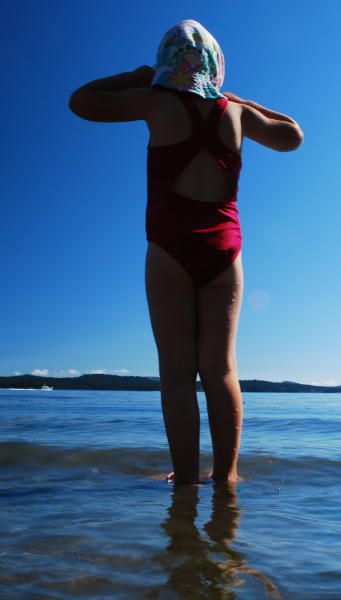
One August day the family, us grandparents, our daughters and grandchildren, all drive down the road, over the hills and down to the ocean at Beddis Beach. On this rocky island, bathing beaches suitable for children are not that common. We park and walk down the leafy trail to the shore. A sunny day, the tide about half way up, several families sitting on beach logs or splashing warily in the shallows. Calm, except for the steady roll of waves from the passing stream of yachts out in Ganges Harbour. The little children run to the water and pause. Those waves! That four inch surf! With a shriek they rush in and with a shriek they run out again! That water is cold!


I have my camera of course, pictures of grandchildren are always in demand within the family ( and mostly not elsewhere), and I can see that this wild rushing in and out, the unselfconscious attitudes of these little bodies, has some interesting possibilities. I hate photos of children taken from adult eye level, small, big headed and down there, so I choose a reasonably wide angle to be sure I can capture a big enough slice of the scene and hand hold the camera at beach level. I will miss lots this way but with digital I can also take lots. Somewhere, sometime, if I keep clicking I might just catch something worth keeping.


This kind of photography requires a different approach from the carefully composed and organized shots of much landscape photography. It is all happening in the spit second, full of movement and changing expressions. Horizons angle wildly and add a sense of action. By the time I see a great shot it will be past so I set out to harvest images within a field of view relying on the beginning of an action sequence to prompt me to start shooting. I miss a lot and I catch a lot this way, but this approach feels appropriate to the subject, to the moment. Shriek!


Walking on the bottom of the sea


The sun is just cresting the dark bulk of Reginald Hill, the morning air carries the first chill of Autumn and at the head of Fulford Harbour the tide is far, far out. A sandy flat seems to stretch almost to the horizon. It is a vivid seaweedy green in the first rays of light. I stop the car and take my camera for a walk on the bottom of the sea.


Luckily I am in my rubber boots, the flats are streaming with water and masses of squishy weed (except, I notice that one boot is leaking and soaking my sock) , but now I am here it is difficult to make interesting images. A large, wet, green plain with a distant rim of water, hills and glaring sun. Somehow, I must capture the reality of the sea bottom in an interesting way. A photograph is not just a record of something else but a new creation with its own inner relationships. Just ahead I see three rocks and gratefully position them in the foreground of my composition. Now at last there is something happening, a triangular pattern organizes the picture and everything now is related to it. I grasp the vastness of the beach-scape in relation to these rocks.


The sun is dimmed by cloud for a few moments and the bright green and the glare disappear. The sand, the blankets of weed, are dark forms enclosing pools of cool light from the sky. This change in light is dramatic and makes a whole new series of photographs possible. I also begin to vary the angle of my photos, looking down on details at my feet or placing the camera at sand level. Suddenly, back comes the sun to reflect brightly in the pools. Down at the level of the sea bottom I see the detail, the rivulets, the roils of weed.


Still, I can only make so much of this and search for some new element. Way off down the beach a big waterlogged fir tree is semi sunk in the sand, its trunk and branches encased in mussels and flying streamers of weed. I walk that way, snapping as I go, because one never really knows what will turn out to be useful later. At my new subject I take several angles, settings and ‘zooms’ and finally I place the camera behind a seaweed-draped branch and shoot from within the cast shadow. No glare, but black arm and backlit weed.


Right down at the water`s edge it is obvious that while the beach water is still streaming to the sea, the ocean itself is quickly moving back inland. This is a place of shifting boundaries and amorphous reflections. In the half hour I have been on the beach the light has changed several times. Once again I need a form to anchor my image and just out there is a black piling left over from some log booming from years ago. I wade into the shallows to get a better angle (my foot cannot get any wetter), squat carefully so the seagull and top of the piling will jut above the hill beyond and click away. A few boat waves rustle the sea`s calm surface.


I walk back along the steeper upper beach to the rattle of pebbles under my feet, the occasional down-spiral of maple leaves and dark shadows under overhanging branches. I begin to look away from the sun toward the brightly lit shore; branches, sun-bleached logs, big rocks, brightly coloured leaves. There is plenty of structure here, it is now a matter of selection, of isolating a few powerful shapes, colours and textures. The very opposite design problem from the flat beach behind me which is now rapidly filling with the sea once more.


Back at my car I pause to look back over the bay. In an hour I have taken many photos, mostly in difficult lighting conditions. I have explored a beach and found ways to tell its story in images. When I started, I simply walked down to the briefly exposed bottom of the sea and started interacting with this place with no clear agenda or idea of how to photograph it. An adventure! What I found there was partly the beach at low tide, partly the rising sun and time of year but also what I myself brought to it in terms of my picture making experience and preferences. That was actually hard work of the creative kind: camera settings, lens choices, shooting angles, the ability to visualize what this particular shot would look like in picture form. A challenge ready for me to take up. The satisfaction of working with a camera to picture something so transient, so dazzled in light on this early Fall morning.


                                               ......................................................................................


Note. Many who live on the island have seen the big petroglyph boulder between the cedars at Drummond Park, a reminder that there were people here for thousands of years before us recent immigrants arrived. There is a story that once that broad shallow beach, where the big boulder originally sat, was dry land until the great waves of a storm or tsunami claimed it back for the sea. Perhaps there was at one time a gravel bar, a lagoon and a village here that was swept away. It may even be a long ago memory from a time of rising sea levels. To walk far out into that weedy world is to step into prehistory a little. In the glaring light, the falling leaves, the moving tide, is an ancient world speaking to us.

Monday, September 5, 2011

The raft people #5 They reach the sea at last.


When I started this model adventure series it was a chance to try out my new mini camera,( a Samsung T 70. ) I had become hooked on the possibilities of model photography earlier with a series I had done with a paper model canoe and its two paddlers and thought that a raft and modeling clay characters sailing on my pond would be fun to try. By combining a real photo of an imaginary scene with some photoshopping touch-ups I had developed a photo technique for storytelling in picture form.( Hang on, isn`t that movies?)


The raft people sailed on the pond ( a large lake to them) and then lived through an icy winter, - even ice sailing through a blizzard. With Spring, they dismantled their raft and built two narrow ones for following the stream to the sea. We met them last, portaging around a waterfall.


The scene opens with the raft reassembled and sailing along a long sandy shoreline. They sight a sailing ship that dwarfs their own raft ( the ‘Monshulu’, see Eric Newby`s ‘The last Grain Race’) and sail hard to catch up. They surge alongside and find the ship is in difficulties, trapped in shoaling waters. Before they know it the ship is broadside in the surf and the raft, which draws little water, can be of assistance even though waves are sweeping their decks. The dinghy is launched to carry a line to the Monshulu, but, alas, it fills with water and the paddler is lost ( raft people do not float).


An anchor is eventually carried out to deeper water, the ship is warped off and saved, but the three raft survivors have some difficult decisions to make. To carry on along this unfamiliar coastline with only three crewmembers or ship their raft as deck cargo on a voyage across the ocean. Will they struggle on or will they eventually sell the raft in Japan as raw logs?

Monday, August 15, 2011

The tangles. Westcoast Thoughts.


 While I have been making relatively bare and simple images in the past few months, - simplifying for strength and clarity -, I am also making complex images where the ‘point’ is clothed in layers of vegetation that are difficult to get past and really see what is going on. Mt. Maxwell is glimpsed through tangles, the little waves breaking on the beach are seen through branches, and the houseboat in the bay is sandwiched between tree trunks.


This is the reality of living on the raincoast that I am imaging here. We live at the foot of great trees and mountains and peer out at the world through the filters of our environment. It affects how we think; it is not easy to see the forms of our lives, the dominant pattern, through the crisscross of daily events and conflicting obligations.


So, these dense images that I make are important for me, are my reflection, but through my fascination for these interwoven lines and textures there is a crisscrossed web way of thinking developing for me as well. My world, my way of seeing it in its complexity of lines and shades of meaning.

Monday, July 25, 2011

At Batoche.

Saskatchewan #6

I wrote this piece as an accompaniment for the photos, to illustrate how in this kind of photography it is not the spectacular image that is important so much as the one that gets closest to a truth; about a people, a place, a history, and the present day reality that has grown out of that past.


The Answer is Blowing in the Wind.

Why should we be concerned about the proportion of our European or Indian blood? Since we have some of each, gratitude and filial love command us to say: “We are Metis!” Louis Riel


Driving north of Saskatoon to a point on the prairie overlooking the South Saskatchewan River we came to the National Historic site of Batoche, the site of the final battle that broke the North-West Rebellion. A new interpretive center with the first of a series of dioramas, the old original church and residence that were built just a year before the defeat of the Metis in 1885 ( still showing the holes of musket balls), who were lead by Gabriel Dumont and Louis Riel. A graveyard full of historic family names and the mass grave of those Metis killed in the four day battle. A separate graveyard for the British soldiers. Depending on your viewpoint, a rebellion or a resistance. How to photograph this? How to understand it?


My daughter held up a card, “ There is a photographic contest, Dad, for several historic sites in Saskatchewan. Do you want to have a go?” We proceed in loose order across the field, toward the church, cameras at the ready, looking intently for the best targets. I crouch behind a wooden wheel and shoot from between the spokes. Closer in, I angle a shot up the spire and then fire from behind a tree (several shots just to be sure). I then edge my way along the picket fence to the church door. And in the entrance I pause for what I will realize later is the most important shot of the day.


Above the door is a painted circle, the only sign, apart from the dioramas back at the interpretive center and a Louis Riel quote on a notice board, of the native Indian half of the Metis` heritage. This round ‘tipi door’, painted on this white frame structure, gives me a sudden insight into the unique reality of the lives of these people of the Prairie from not so long ago, who refused to be put down by the Canadian Government without a struggle. Who so valued their way of life that they would resist a government that the peoples of the Saskatchewan knew had been imposed upon them and was irresponsible in its care of them. They fought well here at Batoche for four days and were finally beaten by a trained army. The reverberations of their resistance are still blowing through the separate graveyards on the prairie wind.


Note. Riel was captured at Batoche, sickened by the killing, and at the end of his trial, before the verdict, before they hanged him as traitor, he asked to make a statement. It was a rambling affair spoken in English. His legal defense had done their best to save him through a plea of insanity and that would not have been difficult to do, but Riel refused that because then all that the ‘half breeds’, as he referred to his people, all that his life and their lives represented and had been given for, would be dismissed as crazy and pointless.

Not an official Canadian hero, then, or for many years thereafter, but a great man of the people nevertheless.